
US Visa Restrictions 2025: Affected Countries and Total Ban
Por: Inmigracionyvisas.com - Octubre 17 2025.
On June 4, 2025, President Donald J. Trump signed Proclamation 10949, titled Restricting the Entry of Foreign Nationals to Protect the United States from Foreign Terrorists and Other National Security and Public Safety Threats. The new rules came into effect on June 9, 2025, at 12:01 a.m. EDT.
This proclamation imposes full and partial travel bans on nationals of 19 countries, affecting both immigrant and nonimmigrant visa categories, with a number of important exceptions. Below is a detailed breakdown: which countries are affected, the criteria, what exceptions exist, and how this affects families and visa applicants.
Table of Contents
- Which Countries Are Affected?
- Legal Basis & Criteria
- What Exceptions or Waivers Exist?
- How the Ban Affects Families & Immigrant Petitions
- Who Is Impacted & Edge Cases
- Possible Expansion & Future Risks
- What You Should Do If You or Your Family Are Affected
- Frequently Asked Questions
- Expert Summary
Which Countries Are Affected?
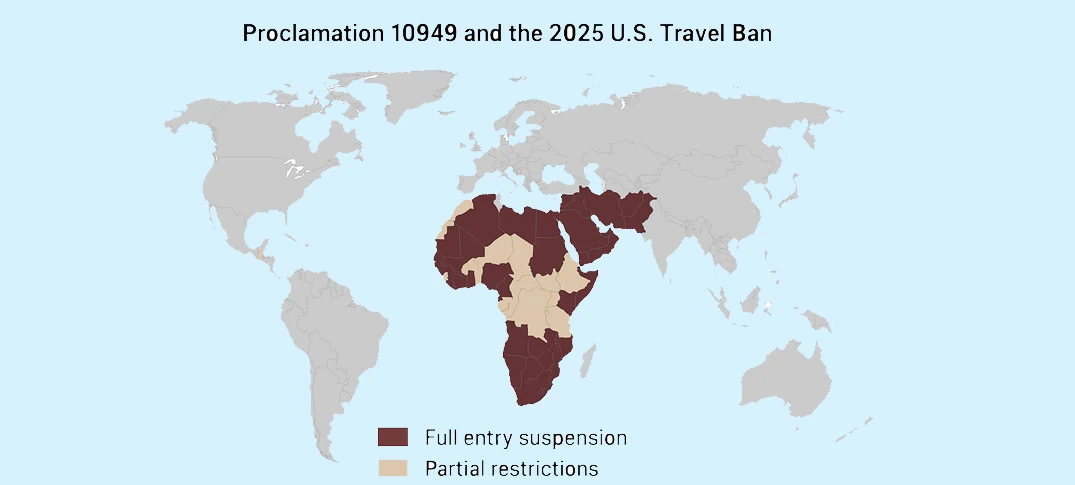
Full Entry Suspension (12 Countries)
Nationals of these twelve countries face a complete prohibition on entry to the U.S. in both immigrant and nonimmigrant visa categories (with limited exceptions):
Afghanistan, Burma (Myanmar), Chad, Republic of the Congo, Equatorial Guinea, Eritrea, Haiti, Iran, Libya, Somalia, Sudan, Yemen.
Partial Restrictions (7 Countries)
Nationals of these seven countries face partial limits—some visa categories are restricted, but not a total ban across the board:
Burundi, Cuba, Laos, Sierra Leone, Togo, Turkmenistan, Venezuela
In practice, for these countries, certain nonimmigrant visas (visitor, student, exchange, etc.) may be blocked, though some segments might still be allowed under narrow conditions. ↑
Legal Basis & Criteria
Authority
The Proclamation relies on sections 212(f) and 215(a) of the U.S. Immigration and Nationality Act (INA), which grant the executive branch powers to suspend or restrict entry of aliens when deemed necessary for national security or public safety.
Criteria Used
The administration cites a few key reasons for designating these countries:
- Deficiencies in identity verification, vetting, or information sharing — some countries were judged unable to reliably confirm identities or share data with U.S. authorities.
- High visa overstay rates — nationals from some listed countries have historically had high rates of visa overstays in the U.S.
- Lack of cooperation in accepting deported nationals — some countries refuse or hinder repatriation of nationals ordered removed from the U.S.
The Proclamation states that publicly disclosing all intelligence or rationale would be harmful to national security, so many justifications remain classified . ↑
What Exceptions or Waivers Exist?
Although the bans are sweeping, there are important exceptions and case-by-case waivers. Those who may still enter despite being from affected nations include:
- Lawful Permanent Residents (Green Card holders) of the U.S.
- Spouses and children of U.S. citizens, subject to “clear and convincing evidence” of the relationship and identity.
- Existing visa holders (i.e. those who already hold a valid visa before June 9, 2025), in many cases their visas are not revoked.
- Special immigrant visas for Afghans who assisted U.S. forces (e.g. interpreters, etc.)
- Individuals whose entry is found to serve U.S. national interest — the Secretary of State may grant discretionary waivers in narrow circumstances.
- Diplomats, certain athletes, or participants in major international events (e.g. Olympics, World Cup)
- Dual nationals holding a passport from a non-banned country (if entry on the non-banned passport is possible)
- Adoptions and certain humanitarian cases may also qualify for exceptions.
One important clarification: visa holders issued before the effective date (i.e. prior to June 9, 2025) generally will not have their visas revoked solely because of the new ban. However, consular officers may still review each admission case, and border officers retain discretion ↑
How the Ban Affects Families & Immigrant Petitions
This is one of the most consequential aspects, especially for people with close family ties to the U.S.:
- Family-based immigrant visas are heavily impacted. According to one analysis, about 51% of immigrant visas affected by the ban are in family-based categories (i.e. siblings or adult children of U.S. citizens, spouses/unmarried children of lawful permanent residents).
- Many visa petitions currently pending for nationals of these countries may be delayed or denied if they don’t fall under an exception or waiver.
- For families abroad: even if a U.S. citizen files a petition for a spouse, child, or sibling from one of the banned countries, that beneficiary might be unable to obtain visa processing or travel to the U.S. unless they qualify under an exception.
- For dependent children or parents: the exception for “spouse or child of U.S. citizens” does not necessarily cover extended family or siblings, unless specifically allowed under the waiver provisions.
- Some adoptees or humanitarian cases might still proceed under adoption or special family-based rules, but they face greater scrutiny.
The ban also undermines family reunification goals, and critics argue it disproportionately harms immigrant communities from the affected nations. ↑
Who Is Impacted & Edge Cases
Here’s a breakdown of who is and isn't affected, and some edge scenarios to watch out for:
Affected
- Nationals of banned countries who are outside the U.S. as of June 9, 2025 (and do not hold a valid visa) are barred from entry under the ban.
- Those applying for new visas after the date of enforcement from banned nationalities are subject to the restrictions.
Not (or less) affected
- Nationals who already are in the U.S. on valid visas may not be forced to leave solely because of this policy.
- Those holding valid visas issued before June 9, 2025 generally retain them.
- Permanent residents, U.S. citizens, and some family relation categories may remain eligible under exceptions.
- Dual nationals who have passports of both a banned and non-banned country might enter on the non-banned passport, depending on circumstances.
- Some waivers or national interest exceptions can allow travel in special cases. ↑
Possible Expansion & Future Risks
- The Trump administration is reportedly considering expanding the ban to an additional 36 countries.
- Starting September 2, 2025, the Secretary of State can submit recommendations every 180 days to add or remove countries from the list.
- This means that even countries currently not on the list should watch developments closely. ↑
What You Should Do If You or Your Family Are Affected
- Consult an immigration attorney immediately — the exceptions and waivers are complex and applied case-by-case.
- Gather proof of relationships and identity — especially for spouses or children of U.S. citizens, you may need “clear and convincing” evidence.
- If you have a visa issued before June 9, 2025, try to travel before the enforcement date if possible, as visa issuance or entry after that point might be blocked.
- For students and scholars (F, J, M visas) — if you depart the U.S., reentry may not be guaranteed even with a valid visa.
- Monitor updates — as countries could be added or removed in future reviews under the Proclamation.
- Consider alternative routes — e.g. special humanitarian visas, waivers, or national interest exceptions may apply in narrow scenarios. ↑
Frequently Asked Questions
Twelve countries are under a total entry suspension, including Afghanistan, Iran, Libya, Somalia, Sudan, and Yemen, among others. Nationals from these countries cannot obtain most immigrant or nonimmigrant visas, except in limited cases.
U.S. lawful permanent residents, spouses and children of U.S. citizens, dual nationals traveling on a non-banned passport, and those granted a national interest or humanitarian waiver may still enter the U.S.
Family-based immigrant visas from affected countries may face long delays or outright denials. Even approved petitions can’t proceed if the beneficiary is subject to the ban and does not qualify for an exception.
Estimates suggest that the proclamation could block tens of thousands of entries each year — roughly 34,000 immigrant visas and over 125,000 nonimmigrant visas annually from the impacted nations.
Yes. The Secretary of State must review the list every 180 days and can recommend adding or removing countries. That means more nations could face restrictions—or some could be lifted—in future updates.
Expert Summary:
Proclamation 10949 marks one of the most sweeping travel and visa restriction measures in recent U.S. immigration history. By fully suspending entry from 12 countries and partially restricting 7 more, it endangers existing immigrant petitions, disrupts family reunification.
Based on current reports, Proclamation 10949 may block tens of thousands of immigrants and non-immigrants annually — estimates suggest at least 34,000 immigrant visas and over 125,000 non-immigrant visas could be affected each year from partially restricted countries. However, exact numbers of people denied entry because of the travel ban alone are not yet publicly available. ↑